
Short answer: it depends entirely on the portion size you cut. An 8-inch round cake serves 24 at a wedding portion (1"×2"), 20 at a party portion (1.5"×2"), 12 as dessert (2"×2") and 48 as finger slices (1"×1"). Any chart that gives one number per cake size has silently picked a portion size for you.
This page gives you the whole grid: every round size from 4" to 18", at all four standard portions, plus squares, other shapes, tiered combinations, and the cutting method that actually produces the count.
Round cake serving chart
This is the table most people are looking for. Diameters in inches, sizes down the side, portion size across the top.
| Cake size | Finger 1"×1" | Wedding 1"×2" | Party 1.5"×2" | Dessert 2"×2" |
|---|---|---|---|---|
| 4 inch | 12 | 6 | 4 | 3 |
| 5 inch | 16 | 8 | 6 | 5 |
| 6 inch | 24 | 14 | 9 | 6 |
| 7 inch | 32 | 17 | 12 | 8 |
| 8 inch | 48 | 24 | 20 | 12 |
| 9 inch | 64 | 32 | 24 | 16 |
| 10 inch | 76 | 38 | 28 | 19 |
| 11 inch | 92 | 46 | 30 | 23 |
| 12 inch | 112 | 56 | 40 | 28 |
| 13 inch | 128 | 64 | 46 | 32 |
| 14 inch | 156 | 78 | 56 | 39 |
| 15 inch | 176 | 88 | 66 | 44 |
| 16 inch | 200 | 100 | 72 | 50 |
| 17 inch | 224 | 112 | 76 | 56 |
| 18 inch | 256 | 126 | 86 | 63 |
These are the figures Bake Boost uses in its own cake servings calculator, taken from the printed serving guides bakers have worked from for decades. They assume a standard cake height — roughly 4 inches of finished cake, two or three layers.
What are the four portion sizes?
The portion is the footprint of one slice looking down on the cake. Height is not part of it, which is why a taller cake changes the answer (see below).
| Portion | Size | Where it is used |
|---|---|---|
| Finger / coffee | 1" × 1" | Dessert tables, coffee mornings, a cake served alongside other puddings |
| Wedding | 1" × 2" | The standard formal wedding slice — tall, narrow, served on a plate |
| Party | 1.5" × 2" | The everyday birthday slice and the sensible default |
| Dessert | 2" × 2" | A generous slice served as the only dessert |
If a customer asks "how many does it serve?" and you answer without agreeing the portion, you are both going to be disappointed. The honest answer is "24 the way a caterer cuts a wedding cake, or 12 if you want proper dessert slices."
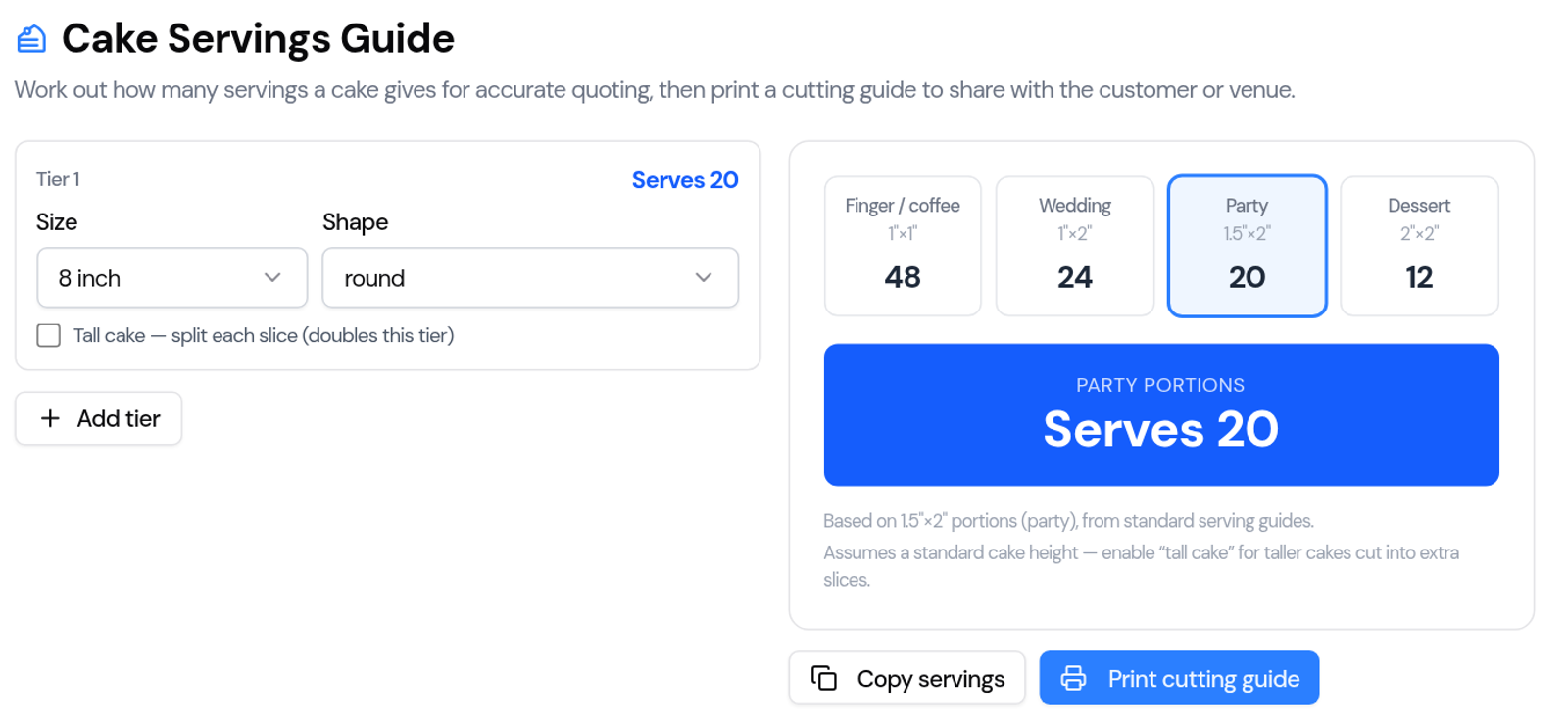
One 8-inch round cake, four legitimate answers. Nothing about the cake changed — only the knife.
Square cake serving chart
A square cake of the same nominal size serves more than a round one, because none of the pan is lost to curvature. These counts come from packing the portion grid into the square:
| Cake size | Finger 1"×1" | Wedding 1"×2" | Party 1.5"×2" | Dessert 2"×2" |
|---|---|---|---|---|
| 6 inch | 36 | 18 | 12 | 9 |
| 8 inch | 64 | 32 | 20 | 16 |
| 10 inch | 100 | 50 | 30 | 25 |
| 12 inch | 144 | 72 | 48 | 36 |
| 14 inch | 196 | 98 | 63 | 49 |
| 16 inch | 256 | 128 | 80 | 64 |
| 18 inch | 324 | 162 | 108 | 81 |
There is a clean reason for the gap. A circle fills only about 79% of the square that encloses it, so a square pan of the same nominal size holds roughly 27% more cake — and at the finger, wedding and dessert portions that is almost exactly what you see across every size in the table. Useful to know when a guest list grows and the customer does not want to move up a tier.
Two honest caveats about square counts. They are a grid calculation, not a printed reference table. And a grid only gains a portion when a whole extra row or column fits, which makes the party column lumpy: at 1.5 inches wide, the columns happen to divide an 8" square no better than they divide an 8" round, so both land on 20. The wedding and dessert columns, which divide evenly, show the expected 1.3× gap throughout. Treat squares as a close estimate, and round down if you are quoting a nervous customer.
Serving counts for heart, oval, hexagon and petal cakes
Shaped tins lose area to their outline, so they serve fewer than the round of the same nominal size. The proportion of a round each shape keeps:
| Shape | Share of the round | 8 inch, party | 10 inch, party | 12 inch, party |
|---|---|---|---|---|
| Round | 100% | 20 | 28 | 40 |
| Hexagon | 87% | 17 | 24 | 35 |
| Oval | 80% | 16 | 22 | 32 |
| Heart | 75% | 15 | 21 | 30 |
| Petal | 70% | 14 | 20 | 28 |
So a 10" heart serves about 21 party portions where a 10" round serves 28 — a difference of seven slices, which is exactly the sort of gap that turns into an awkward phone call.
Tiered cake serving chart
For a tiered cake you add the tiers. Here are the combinations bakers are asked for most, all round, all standard height:
| Tiers | Wedding 1"×2" | Party 1.5"×2" | Dessert 2"×2" |
|---|---|---|---|
| 6" + 8" | 38 | 29 | 18 |
| 6" + 10" | 52 | 37 | 25 |
| 8" + 10" | 62 | 48 | 31 |
| 8" + 12" | 80 | 60 | 40 |
| 10" + 12" | 94 | 68 | 47 |
| 6" + 8" + 10" | 76 | 57 | 37 |
| 6" + 8" + 12" | 94 | 69 | 46 |
| 8" + 10" + 12" | 118 | 88 | 59 |
| 10" + 12" + 14" | 172 | 124 | 86 |
| 6" + 8" + 10" + 12" | 132 | 97 | 65 |
Two practical notes. Tiers are usually stepped 2 inches apart so the cake reads as a tier rather than a wobble. And if the top tier is being kept — for an anniversary, or frozen for a christening — subtract it from the count before you quote.
Does a tall cake serve more?
Yes, and this is the most common missing variable in cake quoting.
The chart above assumes a standard finished height. A tall or double-barrel tier is cut into the same footprint but each slice is split horizontally, so that tier serves twice as many. An 8" round at a party portion serves 20 as standard and 40 tall.
That is a genuine doubling of yield from one tier, and it is also a genuine doubling of batter, so it belongs in both the serving count and the price.
How do you actually cut a cake to get these numbers?
The counts assume the column method, not wedges. Cutting a round cake into wedges from the centre gives you big slices at the rim, slivers at the middle, and nowhere near the chart's count.
The column method for a 10-inch round at a party portion (28 servings):
- Cut the cake into 6 columns, each 1.5 inches wide, straight across the cake.
- Start from the left. Cut the first column into 4 portions, each 2 inches deep.
- Cut the next column into 5.
- The next two into 5 each — these are the widest part of the cake.
- The fifth column into 5.
- The last column into 4.
4 + 5 + 5 + 5 + 5 + 4 = 28. The columns near the edge yield fewer portions because the chord is shorter there, which is exactly why the wedge method cannot hit the number.
Cut cold, with a long thin blade, wiped between cuts.
Why do serving charts disagree with each other?
Because they are answering different questions, and most of them do not say which.
- Different portion sizes. The single biggest cause. A chart that says an 8" round serves 20 has picked the party portion; one that says 24 has picked the wedding portion. Neither is wrong.
- Different assumed heights. A 3-inch cake and a 5-inch cake have very different slice counts at the same footprint.
- Round down vs round up. Some charts quote the theoretical maximum; practical charts shave a slice or two for the cuts that go wrong.
- Wedges vs columns. A chart derived from geometry assumes columns. A baker who cuts wedges will never reach it.
When you quote, state the portion size. It converts an argument into a choice.
Quick reference: the sizes people ask about most
- How many does a 6 inch cake serve? 9 party portions, 14 wedding portions, 6 dessert portions.
- How many does an 8 inch cake serve? 20 party, 24 wedding, 12 dessert.
- How many does a 10 inch cake serve? 28 party, 38 wedding, 19 dessert.
- How many does a 12 inch cake serve? 40 party, 56 wedding, 28 dessert.
- How many does a two-tier 6" + 8" cake serve? 29 party, 38 wedding.
- How many does a three-tier 8" + 10" + 12" cake serve? 88 party, 118 wedding.
Frequently asked questions
How many servings is an 8 inch round cake?
Twenty at a party portion of 1.5"×2", twenty-four at a wedding portion of 1"×2", twelve as a 2"×2" dessert slice, and forty-eight as 1"×1" finger slices. The portion size is what decides it.
Does a square cake serve more than a round cake?
Yes, by about 27% at the same nominal size, because a circle fills only 79% of the square around it. An 8" square gives 32 wedding portions against a round's 24, and 16 dessert portions against 12.
How many does a two-tier cake serve?
Add the tiers. A 6" + 8" serves about 29 party portions or 38 wedding portions; an 8" + 10" serves 48 party or 62 wedding. Subtract the top tier if the couple are keeping it.
Does a taller cake serve more people?
Yes. A tall or double-barrel tier is cut to the same footprint but each slice is split horizontally, so that tier serves twice as many. An 8" round goes from 20 party portions to 40.
What is a wedding portion versus a party portion?
A wedding portion is 1"×2" — tall and narrow, the formal plated slice. A party portion is 1.5"×2", the everyday birthday slice. The wedding portion gives you roughly 20% more slices from the same cake.
How do you cut a round cake to get the full serving count?
Use the column method: cut straight across the cake into columns the width of your portion, then cut each column into portions of your portion's depth. Wedges cut from the centre waste the middle of the cake and will not reach the chart's count.
How many servings does a heart-shaped cake give?
About three-quarters of the round of the same size, because the outline loses area. A 10" heart serves roughly 21 party portions where a 10" round serves 28.
Why do different cake serving charts give different numbers?
Almost always because they assume different portion sizes, and sometimes different cake heights or cutting methods. A chart is only comparable to another once you know which portion it used.
Work it out on your own cakes
Bake Boost has this chart built in as a calculator: enter your tiers, pick the portion, tick "tall cake" where it applies, and it gives you the count and a printable cutting diagram you can hand to a venue. It is on every plan — see the cake servings guide, or read about costing and pricing a cake by the slice once you know the count.